

Home » The Judo You Never Stop Learning: The Vision of Sensei Corrado Croceri
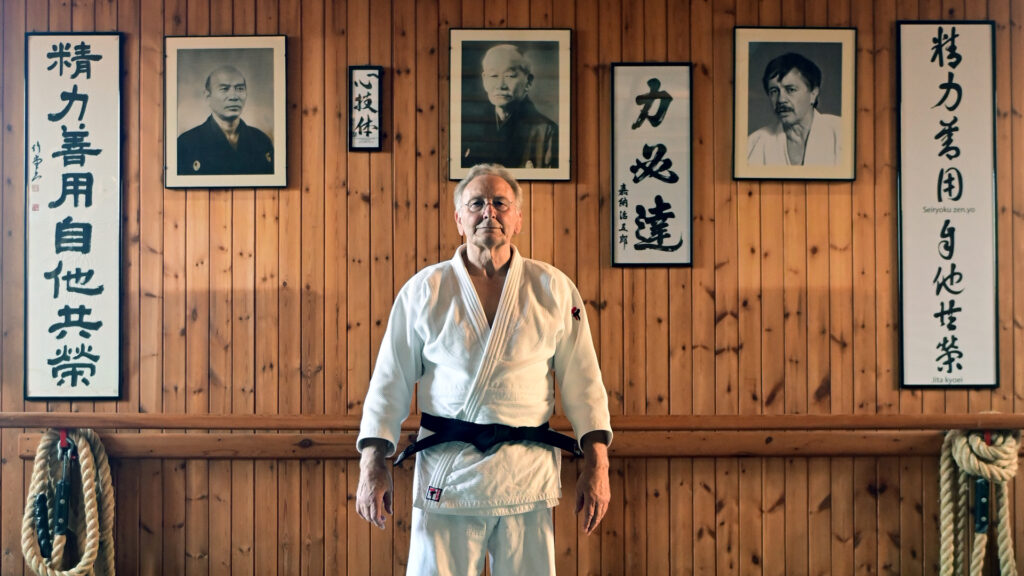
At the end of the 50th anniversary, at the heart of Dojo Kenshiro Abbe, Sensei Corrado Croceri takes us on a journey that goes beyond techniques, beyond physical strength, reaching into the true essence of Judo. This dojo is where principles become visible, where wisdom, discipline, and the search for something greater come together. Croceri reminds us that Judo, as imagined by its founder Jigoro Kano, is more than a sport—it’s a path, a journey of personal growth.
In this journey, every judoka finds their own style, a unique technique that becomes a personal expression, like Sensei Croceri’s famous Hane Goshi. But for him, this is only part of it: “Technique is just a tool,” he says. “Being a good technician isn’t enough. You have to feel part of a family.” This sense of belonging turns training into a dialogue, an open Randori, a conversation where companions learn from each other.
At Dojo Kenshiro Abbe, Judo is taught not only to build physical strength but also to nurture one’s spirituality. Croceri highlights the warrior origins of the discipline, rooted in the ancient martial arts of the Samurai. But he warns that focusing solely on sport performance can make us lose the true meaning of Judo: it’s not just about winning or losing, but about growing and becoming better people, able to face life with courage and mindfulness.
In the moment of Ippon—that magical instant that goes beyond the referee’s decision—Judo becomes a life experience. It’s not a win or a loss, but a confrontation where both people win, as one learns and the other grows. “Living Judo means understanding that each training is an opportunity for improvement,” Croceri continues. The Japanese call it Kaizen, continuous improvement. It’s a philosophy that applies to both body and mind. Training every day means training intelligence as much as the body.
The joy of children running and playing under the Sensei’s guidance is proof of the deep bonds that Judo creates among people. The young students learn to work together, to listen, and to respect their own bodies and those of others. For Croceri, teaching Judo is a social commitment: it means passing on values and teaching the youth that learning never ends.
Conclusion:
The Judo practiced at Dojo Kenshiro Abbe is not just a set of techniques or movements. It’s a philosophy, a discipline that teaches respect, perseverance, and the connection between mind, body, and spirit. It’s a journey that, as Sensei Croceri says, “makes us feel part of something greater.” An invitation for everyone, young and old, to discover this “remarkable unknown” Judo that has so much to offer society.
